From Assistant to Agent: A Maturity Model for AI in Transaction Businesses

Ask a leadership team "how far along are we with AI?" and you will usually get a vague answer — somewhere between "we have ChatGPT licences" and "we're building agents." That vagueness is the problem. Without a shared map, teams over-claim, skip foundational steps, and launch ambitious agent projects on data and governance that can't support them. Gartner expects up to 40% of enterprise applications to embed task-specific AI agents in 2026, up from under 5% a year earlier — but the companies that benefit are the ones who climbed the ladder rung by rung, not those who jumped.
Here is a five-level maturity model adapted for transaction-heavy businesses — payments, commerce, lending, ticketing. Use it to locate yourself honestly and to pick a deliberate next step.
Level 1 — Assisted
Individuals use AI tools (chat assistants, copilots) to draft, summarise, and search faster. The gain is real but personal and bounded: a few minutes saved per task. Nothing about the underlying workflow changes. Most companies that think they're "doing AI" are actually here. It's a fine starting point — just don't mistake it for transformation.
Level 2 — Embedded
AI is built into a specific workflow and acts within one domain. Think automatic transaction categorisation, draft responses to disputes, anomaly flagging in settlement files, or first-pass KYC document checks. The AI doesn't just assist a person on the side — it's part of the process. This is the first level where efficiency starts to show up in the numbers rather than in individual convenience.
Level 3 — Orchestrated
Agents run multi-step workflows end to end, with humans approving at key checkpoints. A reconciliation agent matches transactions across systems, surfaces only genuine exceptions, drafts the counterparty message, and proposes a resolution — then waits for a person to approve before acting. This is where most of the real efficiency multiplier lives, because the agent collapses the waiting and re-keying between steps, not just the steps themselves.
Level 4 — Autonomous within guardrails
Agents handle entire processes within clearly defined limits, and humans manage the exceptions and the policy rather than each case. The agent issues refunds under a set threshold, resolves standard disputes, reroutes a failed payment — and escalates only what carries real risk. Reaching this level safely is impossible without the governance and data foundations described below; it is exactly why so many companies stall at Level 3.
Level 5 — Self-improving and cross-functional
Agents coordinate across domains — payments, support, fraud, growth — share context, and improve from outcomes over time. Few organisations are genuinely here yet, and it is not a goal to rush. It only becomes safe and valuable once the lower levels are solid.
How to use the model
Three rules make this useful rather than decorative.
Find your real level, per workflow — not per company. You might be at Level 3 in reconciliation and Level 1 in customer support. Maturity is uneven, and that's fine; assess workflow by workflow.
Pick the next level for one workflow. Don't skip. The most common failure is a Level 1 organisation trying to deploy a Level 4 autonomous agent. The jump fails not because the model is weak but because the data is fragmented and the guardrails don't exist. Climb one rung at a time on your highest-value workflow first.
Know what each jump actually requires. Moving up is less about better models and more about foundations: clean, connected, real-time data so an agent has a reliable picture; integration so it can act inside your systems; and governance so you can safely raise its autonomy. Each rung up the ladder demands more of all three.
The takeaway
A maturity model turns "are we behind on AI?" — an anxious, unanswerable question — into "we're at Level 2 in billing and ready to move to Level 3," which is a plan. Most transaction businesses are at Level 1 or 2 today. The winners won't be the ones who claim Level 5 on a slide; they'll be the ones who pick their highest-value workflow and climb it deliberately, one rung at a time.
Frequently asked questions
What level should we aim for? The next one up, on your single highest-value workflow. Targeting a level two or three jumps above where your data and governance actually sit is the most common way AI projects fail.
Is Level 5 the goal for everyone? No. Most of the durable value sits at Levels 3 and 4. Level 5 is only safe and worthwhile once the foundations beneath it are solid.
Can we be at different levels in different parts of the business? Yes — and you almost certainly are. Assess maturity workflow by workflow, not as a single company-wide score.
Synque builds composable infrastructure for transaction-heavy businesses, designed so you can climb the AI maturity ladder safely — with the data, integration, and governance each level requires. Book a 30-minute introduction.
Related articles
Back to articles →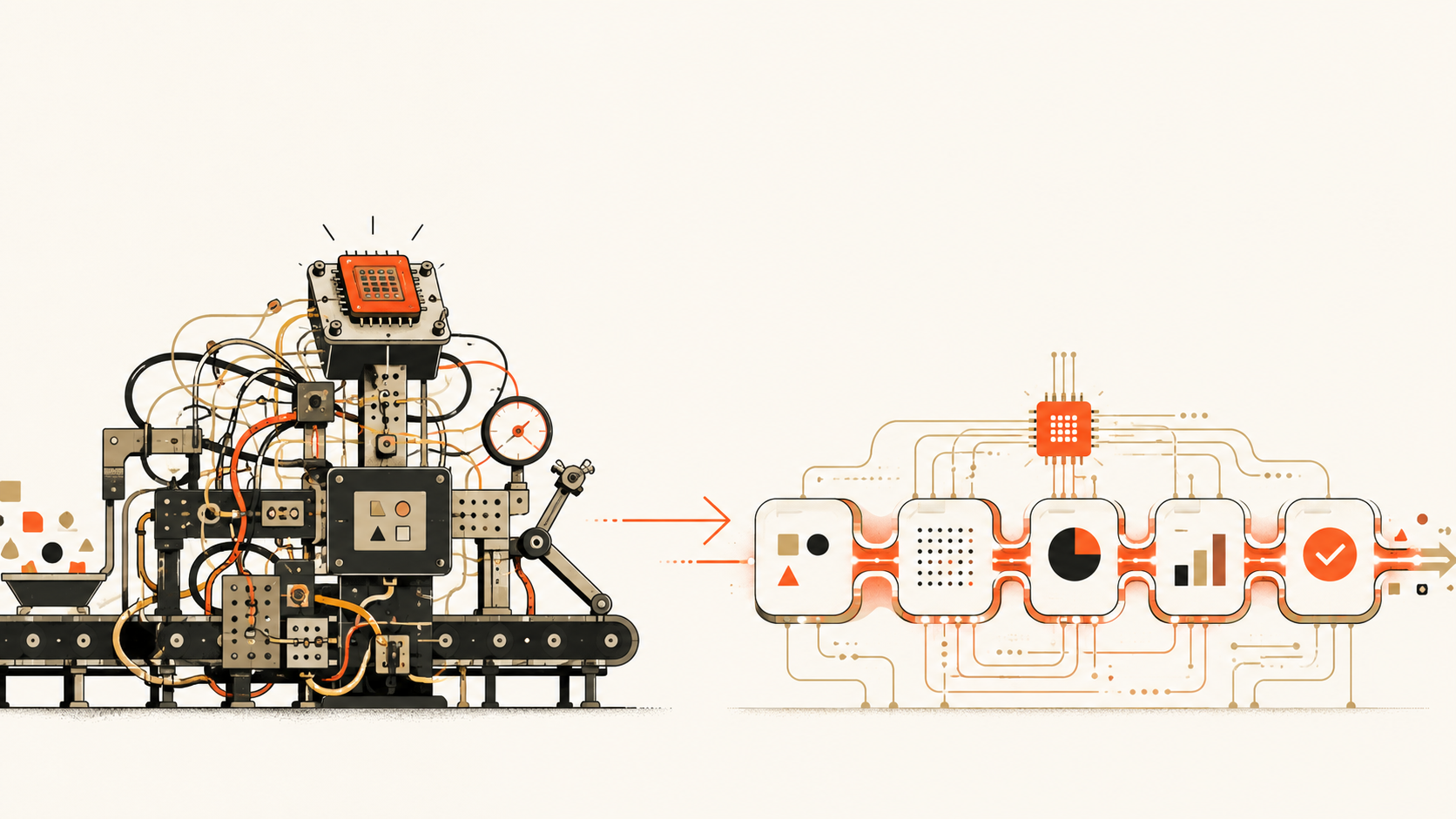
Stop Bolting AI On: The Real Efficiency Multiplier Is in the Workflow
Most companies bolt AI onto a process designed for humans and optimise one step out of twelve. The companies seeing efficiency improve several times over did something different: they rebuilt the workflow around what AI can now do.
Beyond 'We Saved Time': How to Actually Measure AI ROI
The measurement gap, not the technology, is why most AI programs get cut. Here's a three-tier framework — and the metrics that matter for transaction businesses.

AI Governance Is Now a Board Issue: Guardrails That Make You Faster, Not Slower
Why the companies with the clearest AI guardrails are also the fastest — and the six controls transaction businesses need to safely raise agent autonomy.