Stop Bolting AI On: The Real Efficiency Multiplier Is in the Workflow
Almost every company is using AI now. Far fewer are getting a real return on it. That gap is the most important fact in enterprise AI today — and it has very little to do with which model or tool you picked.
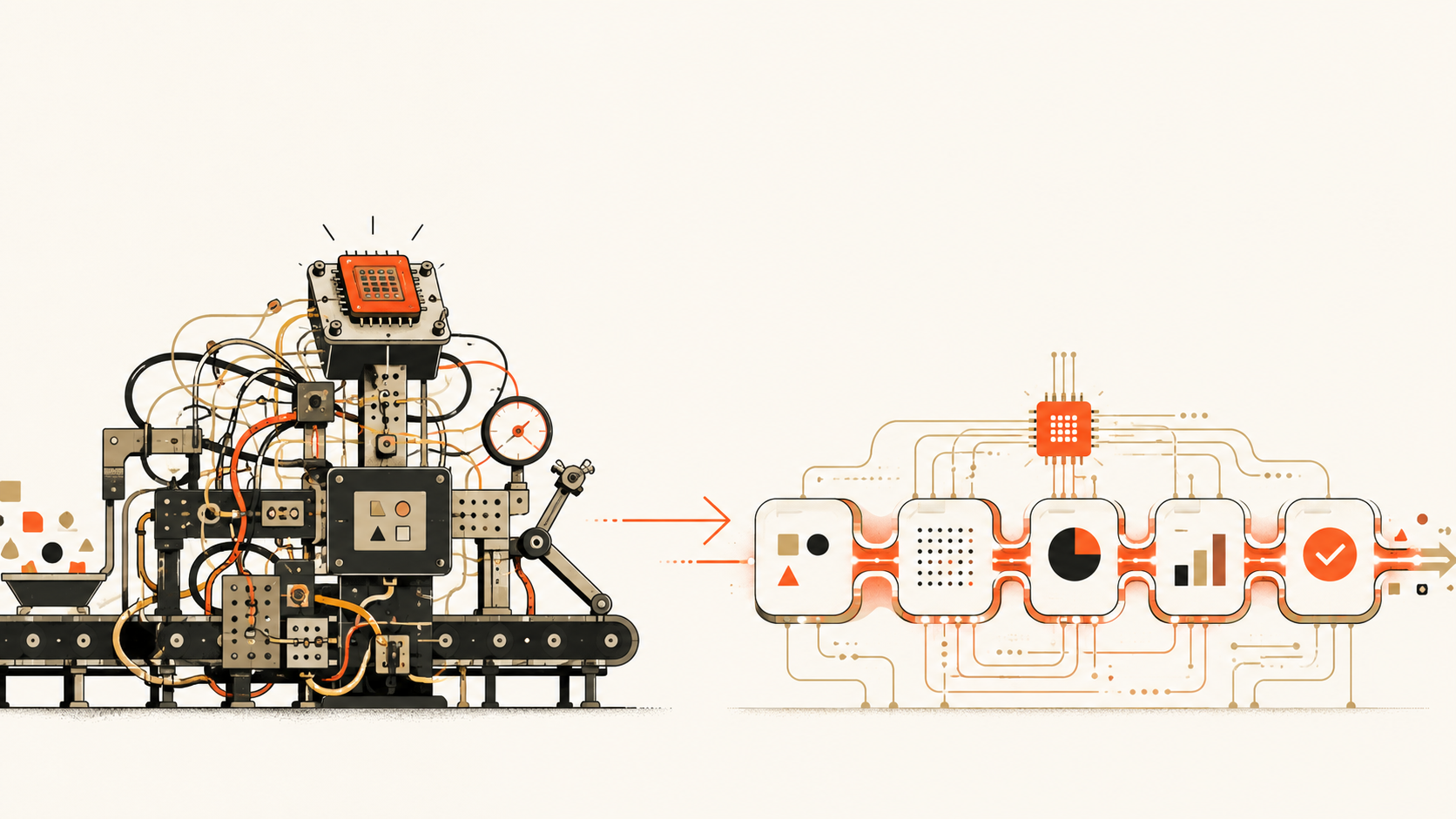
The reason is simple: most organisations bolt AI onto a process that was designed for humans. They drop an assistant into one step, save a few minutes, and call it transformation. The workflow around that step — the handoffs, approvals, manual checks, and rework — stays exactly as it was. You optimise one step out of twelve and end up with a process that is 8% faster. The companies seeing efficiency improve several times over did something different: they rebuilt the workflow around what AI can now do.
The adoption paradox
Adoption is no longer the hard part. Gartner expects up to 40% of enterprise applications to include task-specific AI agents in 2026, up from under 5% a year earlier. Deloitte's 2026 enterprise survey found more companies feel strategically prepared for AI than ever — yet less prepared on the things that actually determine returns: data, infrastructure, governance, and talent.
In other words, the bottleneck has moved. It is no longer "can we deploy AI." It is "have we changed how the work flows so the AI can compound." A tool deployed onto a broken process inherits the brokenness.
"Paving the cow path"
There is an old phrase in operations: paving the cow path. When you pave a winding dirt trail instead of building a straight road, you get a smoother version of the wrong route. Bolting AI onto an existing workflow is the digital version of this. The assistant drafts the email faster, but the email still waits two days for an approval the AI could have handled, then gets re-checked by a person who no longer needs to. The local step is faster; the end-to-end outcome barely moves.
This is why so many pilots stall. They prove a tool works on one task, but the surrounding process never changes — so the gains never reach the bottom line.
What rebuilding the workflow actually looks like
Take a workflow every transaction business knows well: payment reconciliation and dispute handling.
The traditional version looks like this — transactions land in several systems, a team exports reports, matches them by hand in spreadsheets, flags the exceptions, emails counterparties, waits for replies, then manually issues refunds or adjustments. Most of the elapsed time is waiting and re-keying, not thinking.
The bolted-on version adds an AI tool that summarises the exception report. Helpful, marginal.
The rebuilt version starts from the outcome — "every transaction matched, every exception resolved, with a clean audit trail" — and designs backwards from there. Agents continuously match transactions across systems in real time; only genuine exceptions surface to a person; the agent drafts the counterparty message, proposes a resolution, and prepares the refund within preset limits; a human approves the small share of cases that carry real risk; and every action is logged for compliance. The same team now handles far higher volume, exceptions resolve in minutes instead of days, and the audit trail is cleaner than before.
That is a multiple, not a margin.
Four principles that separate a multiplier from a margin
1. Start from the outcome, not the tool. Define the result you want for the whole process, then ask what has to change to get there. Picking a tool first locks you into the old shape of the work.
2. Redesign end to end — especially the handoffs. The biggest time sinks in transaction workflows are rarely the tasks themselves; they are the gaps between them — the waiting, the approvals, the re-keying. AI is uniquely good at collapsing those gaps, but only if you let it touch the whole chain.
3. Put data and governance underneath. AI compounds on clean, connected data and clear guardrails. If your systems cannot give an agent a reliable, real-time picture, it cannot act reliably. And as autonomous agents take on more, governance becomes the thing that lets you move faster, not a brake: define what an agent may decide, what needs a human, and log everything. Fewer than one in five companies has a mature governance model for autonomous agents today — which is exactly why the disciplined ones pull ahead.
4. Decide build vs buy deliberately. The default in 2026 is a blend: most enterprises mix internal builds with vendor solutions, owning the core workflows that differentiate them and buying the commodity edges. Own what makes you different; buy what does not.
How to start: one workflow, a few weeks
You do not need an AI department. Pick a single workflow that is high-volume, high-friction, and full of waiting and rework — onboarding, billing, reconciliation, refunds, or tier-one support. Map it as it really runs, not as the diagram says. Mark every handoff and every place work sits idle. Redesign it around the outcome, decide where a human must stay in the loop, then pilot it on a slice of real volume for a few weeks. Measure against the old way before you scale.
Measure it properly
"We saved time" is not a result. Track end-to-end cycle time, the rework and exception rate, cost per transaction, and error rate — and watch decision quality, which is where the durable value often hides. The point of rebuilding the workflow is that these numbers compound: as the agents handle more and the clean data accumulates, the gap between you and the bolt-it-on competitor widens every quarter.
The takeaway
AI does not multiply a business by being added. It multiplies a business when the work is redesigned around it. Start with one transaction workflow, rebuild it properly, measure the compounding, and repeat. That is the difference between a tool you bought and an advantage you own.
Frequently asked questions
Isn't redesigning a workflow slower than just adding an AI tool? In the short term, yes. A bolt-on ships faster — but it also caps out almost immediately. A redesign takes a few weeks longer and keeps compounding quarter after quarter.
Where should a transaction business start? With the highest-volume, highest-friction workflow that contains the most waiting and rework — usually onboarding, billing, reconciliation, refunds, or tier-one support.
Do we need to build our own AI to get real gains? No. Most enterprises blend build and buy: own the workflows that differentiate you, and buy the rest.
Related articles
Back to articles →
Beyond 'We Saved Time': How to Actually Measure AI ROI
The measurement gap, not the technology, is why most AI programs get cut. Here's a three-tier framework — and the metrics that matter for transaction businesses.

AI Governance Is Now a Board Issue: Guardrails That Make You Faster, Not Slower
Why the companies with the clearest AI guardrails are also the fastest — and the six controls transaction businesses need to safely raise agent autonomy.
From Assistant to Agent: A Maturity Model for AI in Transaction Businesses
A clear five-level map from manual work to self-improving agents — so you can find where you really are and pick the right next step.